EN



Drinking Water Valve Seals: Getting the Documentation Right Before December 2026
1. What actually changes in December 2026
The recast Drinking Water Directive, Directive (EU) 2020/2184, replaced the 1998 Directive and has applied since January 2023. Article 11 introduces a harmonised framework for materials and products in contact with drinking water — in the Commission's own wording, "one standard, one test, one market" for piping materials.
Two dates matter to a valve manufacturer:
- December 2026 — EU hygiene requirements for materials in contact with drinking water begin to apply.
- December 2032 — the transitional period for those hygiene requirements ends.
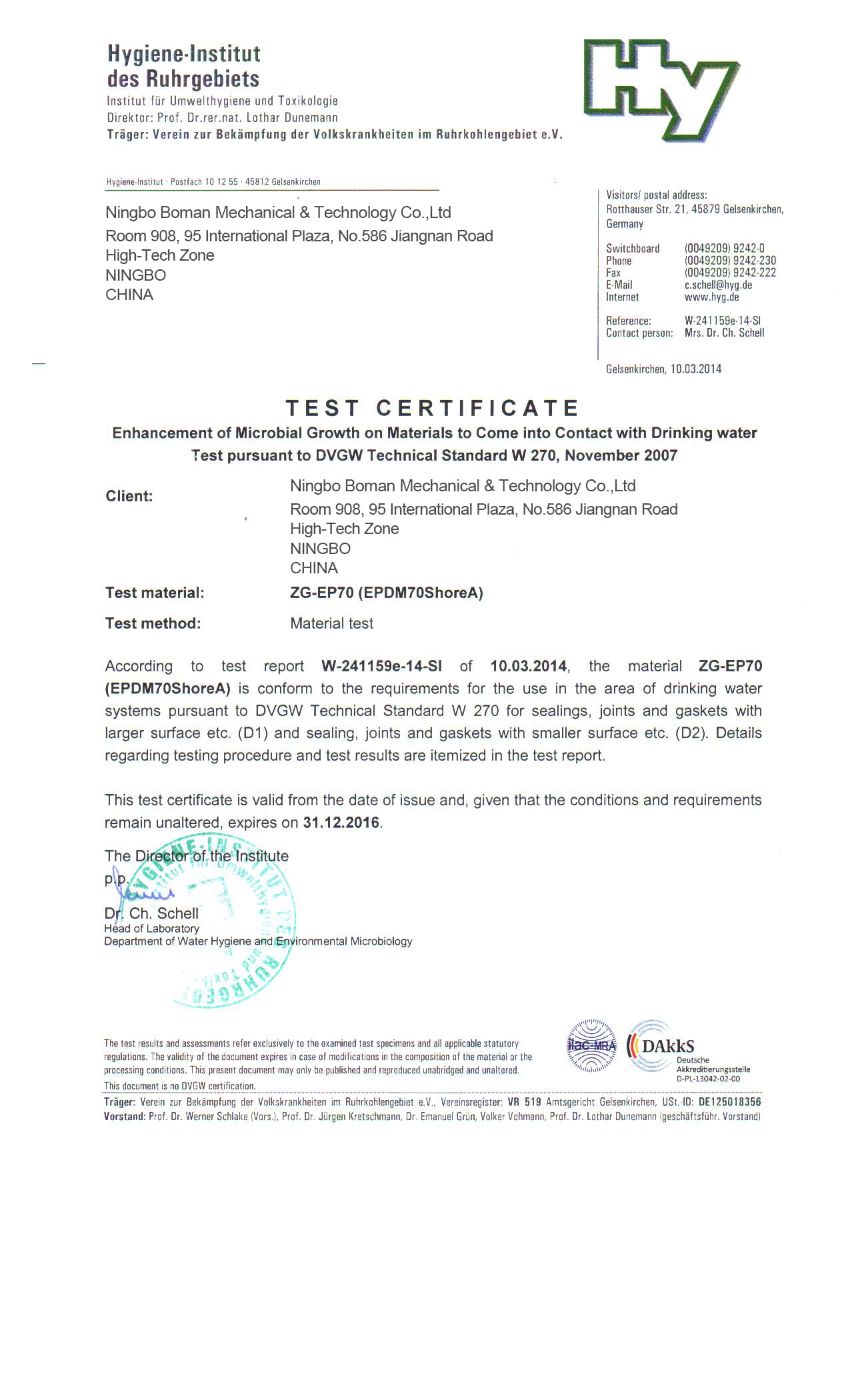
The practical consequence is not a new logo on the carton. It is a test dossier per material: which compound, tested to which scheme, at which laboratory, with which batch behind it. A supplier who cannot connect a certificate to a production lot is, in audit terms, uncertified.
Three schemes dominate European and North American purchasing specs, and most buyers accept a combination of two:
| Scheme | Market | What it evaluates |
|---|---|---|
| WRAS BS6920 | UK | Non-metallic materials in contact with drinking water — odour, taste, appearance, cytotoxicity, metal extraction |
| KTW-BWGL / W270 | Germany | Hygienic suitability of materials in the drinking water sector; W270 covers microbial growth on elastomers |
| NSF/ANSI 61 | USA / Canada | Health effects of wetted components, including gaskets and sealing materials |
2. Where these seals sit, and how they fail
Drinking water valve seals sit in four positions, and each position fails for a different reason:
| Valve type | Seal position | Typical profile | Default compound |
|---|---|---|---|
| Gate valve | Bonnet gasket, stem O-ring | Flat gasket, AS568 O-ring | EPDM 70 Shore A |
| Butterfly valve | Seat liner | Moulded seat ring | EPDM 70–80 Shore A |
| Fire hydrant | Inlet and outlet gasket | Moulded gasket | EPDM 70 Shore A |
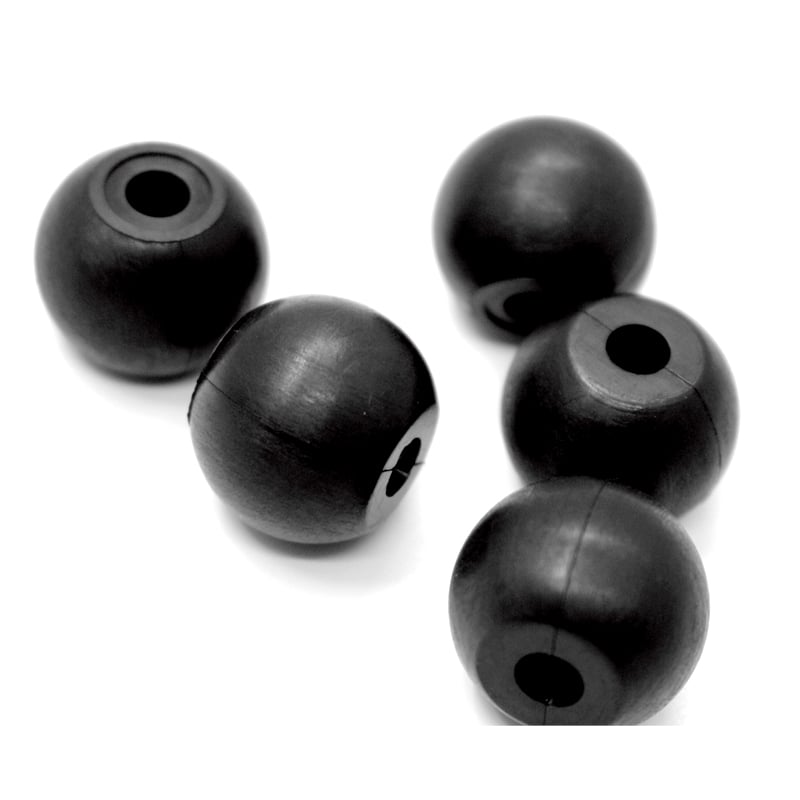
| Ball valve | Ball seat | Moulded ball or seat ring | EPDM 80–90 Shore A |
Across those four positions the same rule applies: potable water valve seals are specified by compound and file, not by profile. It is also why we quote EPDM valve seals by compound name and certificate number rather than by colour.
Most potable water seal failures are not "bad rubber". They are predictable interactions between a compound and a water chemistry.
Failure mode 1 — Compression set under chloraminated water. NBR is the default gasket material in general industry, and it is the wrong default here. Its butadiene double bonds are attacked by chloramine and ozone, and the network degrades faster than the application's 20–25 year design life assumes. The symptom is not a burst; it is a seat that stops recovering, a slow weep that grows, and a valve that no longer isolates a section for repair.
Failure mode 2 — Migration and taste/odour rejection. Plasticisers, processing aids and cure-system residues leach into stagnant water. The valve passes hydrostatic testing and fails the organoleptic panel. On a dead-leg or a low-flow branch — the worst case in any network — the concentration at the seal face is highest.
Failure mode 3 — Installation damage. A pinched O-ring on a sharp gland edge, a rubber ball scored during assembly, a gasket over-compressed by a fitter chasing a leak. These defects are invisible at dispatch and appear as leaks in the first winter pressure cycle.
Design response, in one line: EPDM for the wetted circuit, controlled post-cure to cut volatiles, and a gland geometry review rather than a harder compound.
3. Why EPDM, and why not FKM
EPDM has a saturated polymer backbone. With no double bonds in the main chain, it resists ozone, UV and the chlorine/chloramine chemistry of treated water far better than NBR. For potable water valve seals below roughly 60 °C, it is the material with the best cost-to-compliance ratio — which is why we do not offer FKM as an upgrade on potable water seals.
FKM is chemically more capable and is often specified by reflex. On potable water it is usually the wrong call: it costs several times more, it is fluorine-based and therefore exposed to the long-term policy uncertainty around PFAS, and it brings no benefit at the temperatures involved.
One clarification we make to every buyer, because catalogue tables invite the mistake: a temperature range printed as −60 °C to +220 °C describes the envelope across the compound range, not a single EPDM grade. A potable water EPDM sits in a much narrower window. Quoting the envelope as if it were one material is how seals get specified for conditions they were never tested at.
4. What we changed in the process
The material choice is the easy half of drinking water valve seals. The other half is process control, and this is where a certificate becomes a defensible file.
- Compound route. EPDM grades covered by our KTW-W270 and WRAS certification are used on drinking water seals, not a general-purpose EPDM.
- Incoming material control. Every compound lot is checked before it enters mixing: hardness, tensile strength, elongation, specific gravity and compression set. A lot that fails any of the five does not proceed.
- Mixing and cure verification. Rheometer curves (TS2, TS50, TS90) plus hardness are checked after mixing; moulding runs on 300 t presses with pressure, time and mould temperature monitored as key characteristics, not as operator judgement.
- Post-cure as a controlled step. Oven post-cure with temperature and time held as key characteristics. This is the step that drives off residual volatiles — the ones that cause taste and odour failures — and it is the step most often skipped under delivery pressure.
- Deflashing and cleaning before packing. Flash dust becomes visible debris in a potable water line. Parts are deflashed, cleaned and then packed; OQC re-checks appearance, hardness, dimensions and weight.
- Cavity identification. The mould cavity number is marked on the part. If a single cavity drifts, we isolate that cavity instead of scrapping a shipment.
- Lot traceability. Compound batch → moulding lot → carton label, so a recall covers one lot rather than one container.
5. Qualification protocol
The test plan we run with a valve OEM before the first shipment of drinking water valve seals, and the values we normally agree:
| Test | Standard | Typical acceptance |
|---|---|---|
| Hardness | ASTM D2240 | 70 ± 5 Shore A (flange gasket); 80–90 Shore A (ball seat) |
| Tensile strength / elongation at break | ASTM D412 | Per drawing, agreed at PPAP |
| Compression set | ASTM D395 Method B | 22 h @ 70 °C, target ≤ 25 % |
| Ozone resistance | ASTM D1149 | No cracking at agreed strain and concentration |
| Water immersion / migration | KTW-BWGL or WRAS BS6920 | Pass, third-party laboratory |
| Dimensional | ISO 3302-1 (moulded tolerances) | Per drawing, class agreed per feature |
Two rules we apply to this table. First, the acceptance value is agreed in writing before tooling, not after the first batch. Second, the migration test is run on the production compound, not on a laboratory sample of the same family — auditors check the linkage.
Both rules exist for one reason: a drinking water valve seal is judged by its file, not by its data sheet.
6. The file we hand over
For a potable water programme, the documentation pack contains:
- Material certificate of compliance (KTW-W270, WRAS and/or NSF/ANSI 61 as specified)
- Batch traceability record for the delivered lots
- Third-party migration / immersion test report for the compound in use
- Material data sheet: hardness, tensile, elongation, compression set, temperature window for that specific grade
- Declaration on REACH SVHC and RoHS status
- Change control statement — what triggers a re-qualification and who is notified
Item 6 is the one buyers ask for last and value most. A supplier who will not commit to notification before a compound change is a supply risk, whatever the certificate says.
7. Commercial terms
- MOQ: order value from USD 150 per size — sized for a pilot valve run, not a container.
- Lead time: 15–20 days for a repeat order; up to 30 days in the summer high-temperature period when cure schedules lengthen.
- Samples: free once the order is confirmed, with freight covered.
- Tooling: own mould department and CNC workshop, so a new seat profile does not wait in an external toolroom queue.
- Payment: 30 % T/T deposit, 70 % before shipment.
8. Outcome
The measurable results belong to the customer's records, and we do not publish numbers we cannot evidence. What can be stated is the structural change:
- The wetted circuit moved from a general-purpose NBR to an EPDM grade covered by the potable water certificates, which closed the documentation gap in the buyer's supplier audit for every drinking water valve seal in the range.
- Post-cure moved from "when the oven is free" to a monitored key characteristic, which removed the volatile-driven taste and odour complaint route.
- Cavity marking and lot traceability narrowed the scope of any future containment from a shipment to a lot.
- The qualification effort did not disappear. Every new valve model still needs its own drawing review, first-article approval and migration report — what changed is that the file can be assembled from existing records instead of rebuilt from scratch.
9. If you are re-qualifying a valve seal now
Send these six items and we will return a material recommendation and a quotation, not a catalogue:
- Drawing or sample photo, with the critical sealing dimension marked
- Medium and concentration (free chlorine or chloramine, mg/L)
- Working temperature and pressure, including the sterilisation or flushing peak
- Required certification (WRAS / KTW-W270 / NSF-ANSI 61 / all)
- Annual volume per size
- Target market and the date your technical file must be complete
Samples are free once an order is confirmed. For a qualification project, we will send the material data sheet and the certificate set before you commit to tooling.
10. Frequently asked questions
Are EPDM drinking water valve seals suitable for chloraminated water? Yes — and that is precisely why we specify EPDM rather than NBR for municipal networks. EPDM's saturated backbone resists the chloramine and ozone attack that degrades nitrile rubber well inside a 20–25 year design life.
What documentation do European buyers require for drinking water valve seals? A material certificate of compliance (KTW-W270, WRAS BS6920 or NSF/ANSI 61 as specified), a third-party migration report on the production compound, a batch traceability record, and a written change-control commitment.
Can you supply NSF/ANSI 61 material for the US market? We confirm the applicable scheme at quotation stage, because the dossier has to match the market. If a valve ships to both the EU and the US, specify both schemes up front rather than adding the second one later.
What is the minimum order for a custom drinking water valve seal? Order value from USD 150 per size, with free samples once the order is confirmed. A pilot valve run is a valid first order.
How are drinking water seals different from a standard EPDM gasket? The compound and the file, not the polymer name. A standard EPDM gasket can match the same hardness and still fail the migration test. The grades we use on drinking water seals are the ones covered by the KTW-W270 and WRAS certification, with the test report tied to the production batch rather than to a sample.
Contact: [email protected] · WhatsApp +86 150 8880 0076